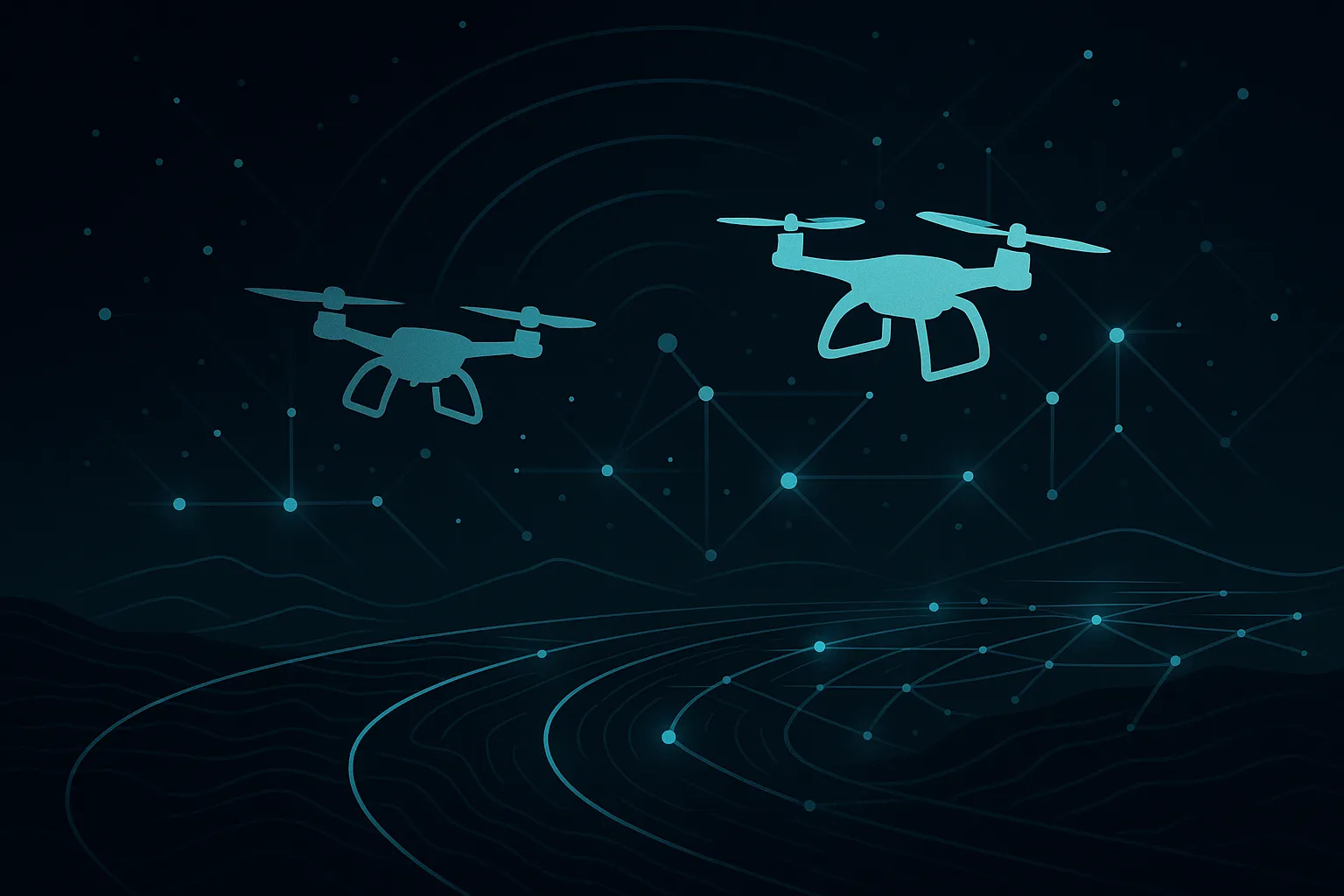
Drone Navigation & Environmental Sensing
Unmanned aerial vehicles have become indispensable tools for surveying, delivery and research. To fly autonomously, drones integrate data from GPS, inertial sensors, cameras and lidar to localise themselves and perceive obstacles. Computer vision and machine‑learning algorithms based on classification, regression and clustering segment images into sky, terrain and obstacles, estimate depth and detect other aircraft. Sensor fusion techniques combine these insights to compute stable flight poses even in GPS‑denied environments.
Drones are also powerful environmental sensors. By mounting multispectral cameras, thermal imagers and chemical detectors, they can map vegetation health, monitor wildlife and detect pollutants. Regression models convert raw sensor readings into meaningful metrics like biomass or temperature, while clustering groups similar features to identify patterns across landscapes. Adaptive controllers adjust flight paths to maximise coverage and battery life, autonomously avoiding obstacles and turbulence.
Coordinated fleets expand the scope of aerial missions. Swarms of drones can cover large areas more quickly than a single vehicle, sharing data and adapting to changing conditions. Algorithms for task allocation and collision avoidance ensure safety, while predictive models forecast wind and weather to optimise routes. Applications range from agricultural monitoring and infrastructure inspection to disaster response and wildlife conservation, demonstrating how AI expands the reach and efficiency of airborne operations.
Responsible deployment is essential. Drones operate in shared airspace and raise concerns about privacy when flying over populated areas. Regulatory frameworks define no‑fly zones, maximum altitudes and requirements for pilot oversight. Designers must account for edge cases like sensor failure, electromagnetic interference or sudden gusts. Transparent communication about data collection and adherence to ethical guidelines will enable drones to serve communities while respecting safety and privacy.
Back to articles
Execution & Costs
Execution quality can make or break a strategy. Simulate market, limit, and algorithmic styles (TWAP/VWAP/POV). Stress test partial fills and queue positioning. Position sizing should be volatility‑scaled, with drawdown brakes and exposure caps. Model spread, fees, and market impact explicitly; then run sensitivity analysis. If a 25% increase in costs wipes out edge, the signal is too fragile for live trading.
Pre‑live, run a paper account to validate latency, fill rates, and alerting. Keep a rollback plan that reduces exposure automatically when live results deviate from your forward‑test confidence band.
Modeling & Monitoring
Tree ensembles and regularised linear models are robust starting points for tabular financial data. For sequence problems, Temporal CNNs, LSTMs or Transformers may help, but only with enough data and careful regularisation. Calibrate outputs to probabilities and translate them into position sizes via monotonic mappings. Monitor drift in features and residuals; trigger re‑training when distributions shift. Audit every change and use canary releases for model promotions.
Practical Research Loop
Start small and iterate fast. Define a tradable hypothesis, pick a liquid universe, and outline clear exit rules before modeling. Feature sets should mix momentum, reversal, volatility regime flags, and liquidity. Label creation must respect time; shift targets forward and lag features to prevent leakage. Every baseline backtest must include realistic costs and slippage so you do not chase phantom alpha.
Use walk‑forward validation or purged K‑fold with embargo windows. Compare against a simple baseline such as risk‑targeted momentum; your ML idea is only meaningful if it beats the baseline after costs. Keep notebooks, configs, and data versions under source control so the results are reproducible.
Governance & Safety
Automated systems demand operational hygiene: access control, secret storage, and separation of research and production. Document data licenses and lineage, enforce code reviews, and require paper‑trading gates before going live. Measure what truly matters—capacity, turnover, risk concentration, and tail risk—not just backtest Sharpe. Optimise for robustness, not perfection of the in‑sample curve.